
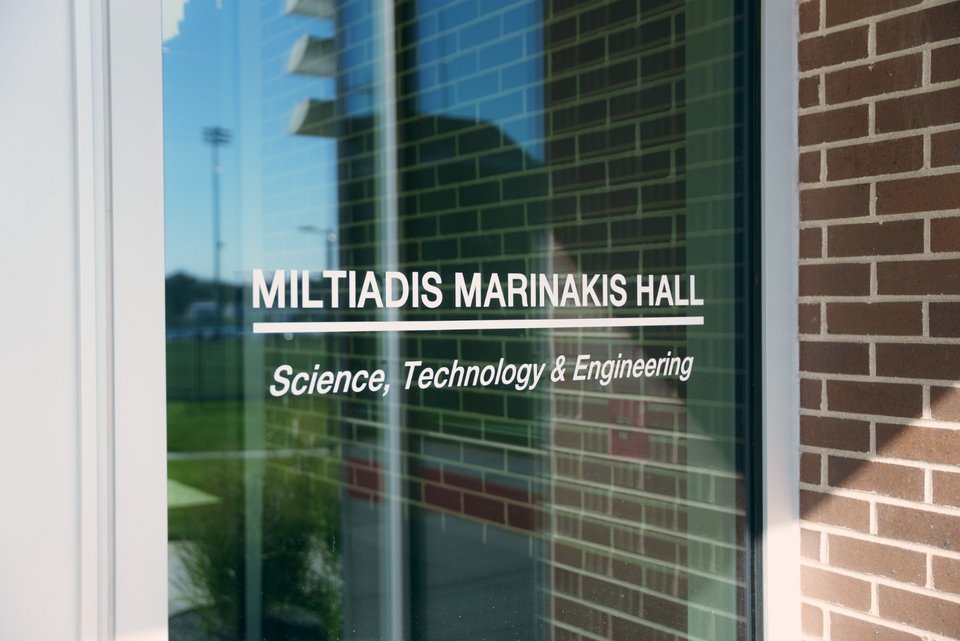
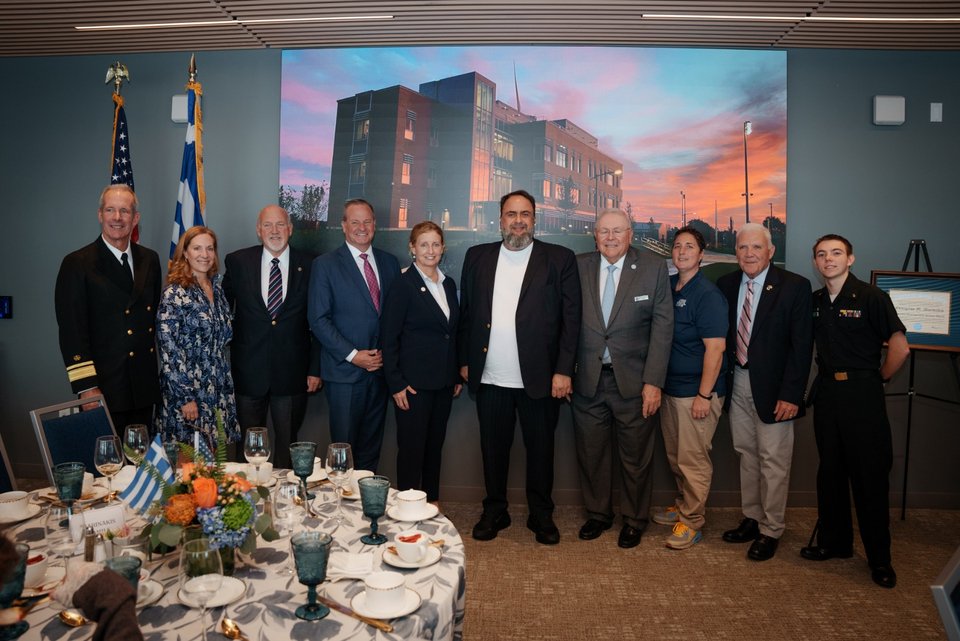
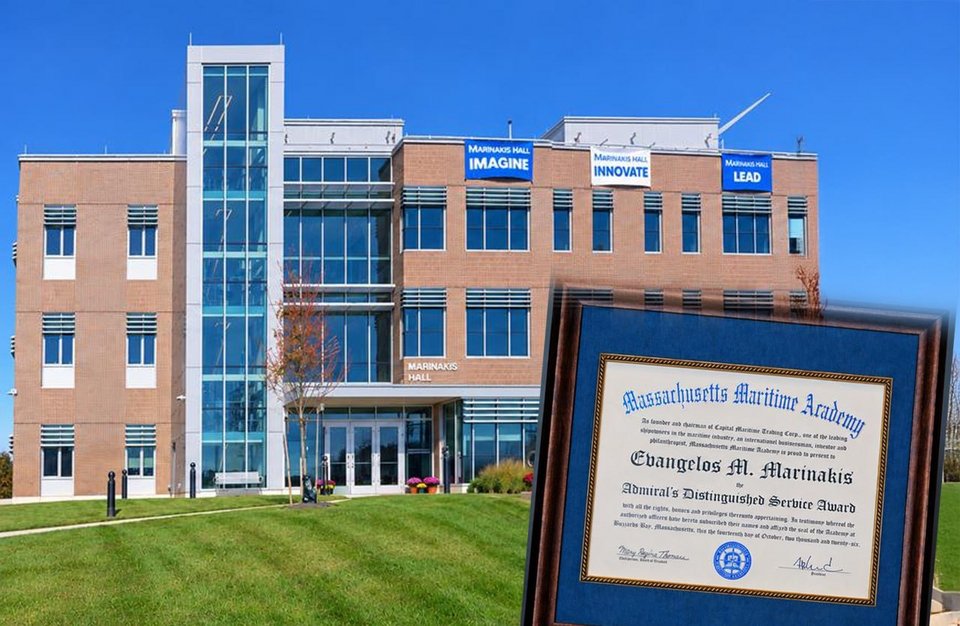
Μiltiadis Marinakis Hall, the newest state-of-the-art STEM (Science, Technology, Engineering, and Mathematics) academic building at the world-renowned Massachusetts Maritime Academy in Buzzards Bay, Massachusetts, was recently dedicated by Academy President Rear Admiral Francis X. McDonald, USMS, and Evangelos Marinakis, founder and chairman of Capital Maritime & Trading Corp., whose generous donation helped make the building possible.
State-of-the-art laboratories across 4,000 square meters
Purpose-built to advance experiential learning in engineering, marine technology and related disciplines, the building contains classrooms and specialized instructional spaces totaling 4,000 square meters, including a fabrication lab, makerspace, operations and controls lab, electronics lab, and dedicated biology, physics and chemistry laboratories. It is also the academy’s first net-zero energy-ready building and the first campus facility connected to MMA’s new geothermal heat loop. Every student at the academy, regardless of major, will take classes in it.
The tour with Evangelos Marinakis and the curriculum
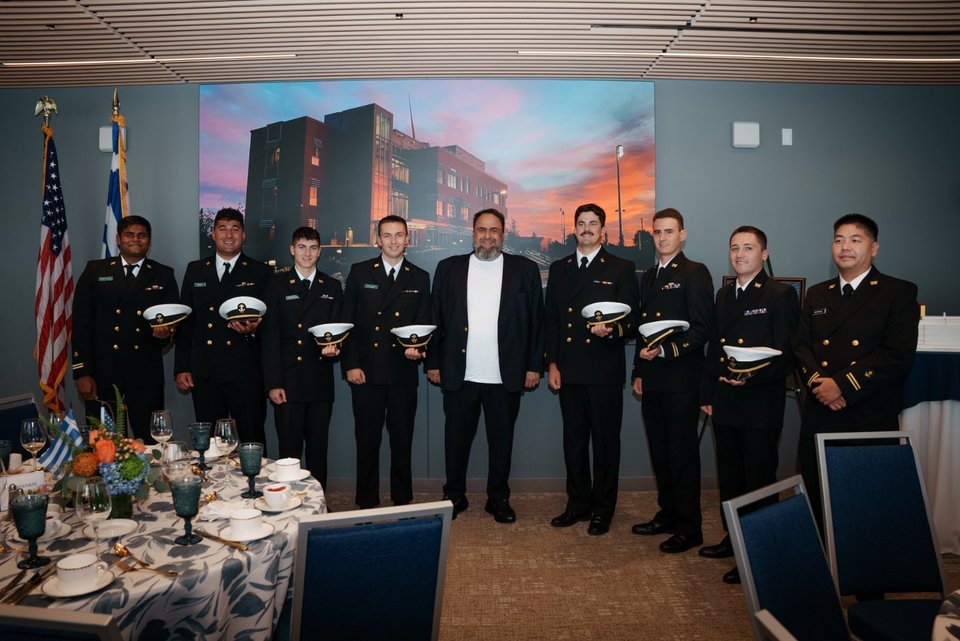
The dedication day began with a tour of the building, led by Rear Admiral McDonald and academy staff. In the laboratories, daily life had already begun before the official opening: faculty and cadets had moved into the new spaces and welcomed Marinakis and his guests amid their work.
The tour also offered a glimpse of how the curriculum takes shape. In the control systems lab, Mark Whalen, associate professor and chair of the Energy Systems Engineering Department, explained that the lab grew out of recommendations from the industry advisory council that meets twice a year: “Several years ago they said we need more automated controls curriculum for our students, and this lab is a result of that.”
The academy is now developing an automated controls concentration that includes programming and robotics, and is in the early stages of developing a nuclear concentration as well. “These students come here with a purpose. They want to get out of here and start doing engineering,” Whalen said.
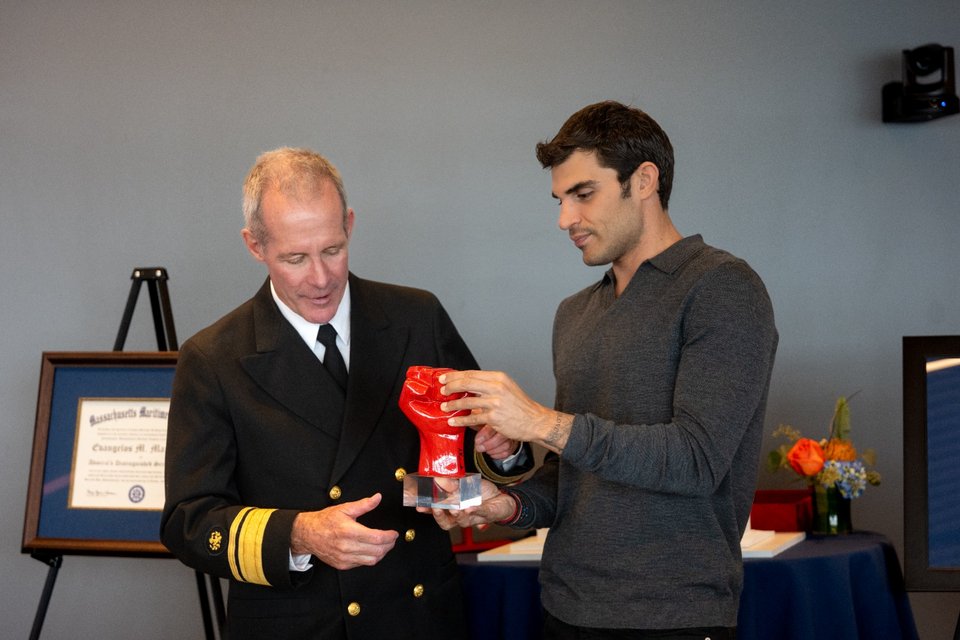
“It’s an important addition to the campus that we wouldn’t have had the opportunity to install without this building coming online,” McDonald added. “It speaks to the importance of the partnership and the generosity of Mr. Marinakis, to add something special for our students that is going to be here for decades and decades to come.”
The profile of the institution
Answering a question from Marinakis about the academy’s degree programs, McDonald described the institution: “For our undergraduate program we sit at about 1,600 to 1,700 students. They study in just seven majors. For the first hundred years, from 1891 to the early nineties, it was just two majors: marine transportation, sitting for the Coast Guard unlimited mate’s license, and marine engineering, sitting for the Coast Guard engineer’s license. In the nineties we started expanding into areas where our alumni already worked: power plant engineering, port operations, emergency management, marine science.”
About 50 percent of the student body is still enrolled in the two original programs, and engineers likewise make up half of the student body. The educational philosophy, he said, rests on three pillars: academics, “six months of real-world education” aboard the training ship and in co-ops and internships, and the Regiment of Cadets as a “leadership laboratory.” “We are not a military college, although 10 or 15 percent of our student body are pursuing a military commission. What we do is expand that regimented environment to 100 percent of our students, for that leadership opportunity, which then translates to employability upon graduation.”
Graduates and jobs
The results show in the placement of graduates. “Two days in the fall and two days in the spring, over 150 organizations pack our gymnasium, set up much like a trade show. They bring with them over 500 human resource and talent acquisition professionals, over a thousand career opportunities, at sea and shoreside, and they’re chasing about 350 graduating seniors. The employability for this institution is second to none,” McDonald said.
“We may not win best party school like some of them, because the students work so hard, but we are at the top in this country for return on investment, year in and year out.” Asked about the participation of women, he replied: “In the last decade we have doubled it, from single digits, because until the fall of 1977 women were prohibited from these institutions. We have now grown to about 80 women in each incoming class of about 400, and we have seen them in leadership roles. The chief engineer of our brand-new training ship is a graduate of Massachusetts Maritime Academy who happens to be a woman.” The chair of the board of trustees, he added, was part of the first class of women who entered the school in 1977 under court order: “I tip my hat to her, because she is soft-spoken and tough as nails.”
The vision for Miltiadis Marinakis Hall
During the tour, McDonald also invited one of the academy’s international students, Cypriot cadet Nicos Pattichis, to greet the visitors. “Welcome. It’s a fantastic institute,” he said. “I believe that with Mr. Marinakis’ vision and his investment, this school can become the number one in the world.”
On the fourth floor of Marinakis Hall, the academy’s president then presented a timelapse video of the building’s construction and conferred on Marinakis the academy’s Distinguished Service Award. A luncheon followed, and then the formal program of speeches, with Rear Admiral McDonald, Marinakis and State Rep. Steven Xiarhos.
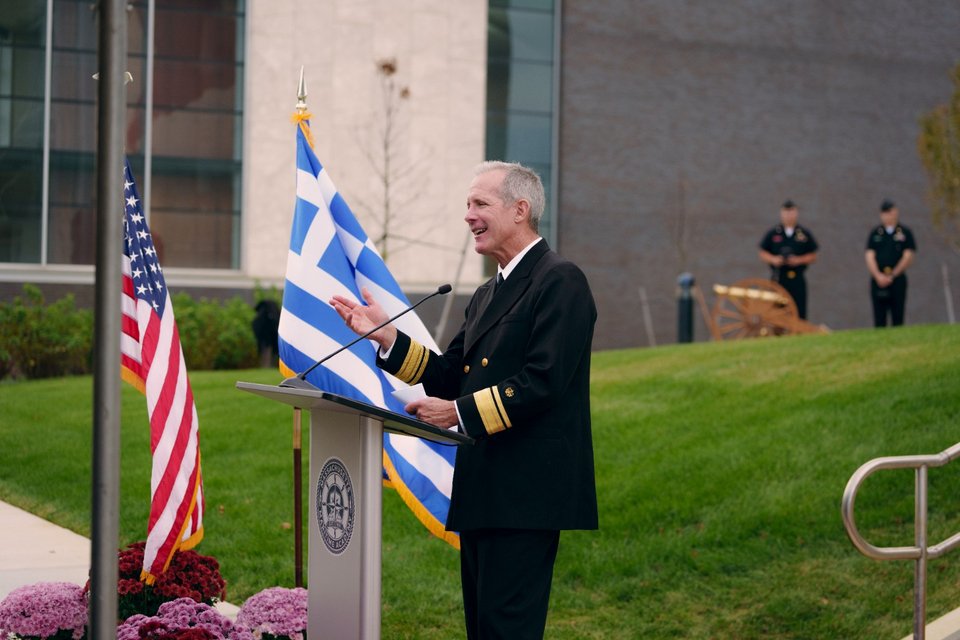
McDonald welcomed Marinakis with the observation that a more fitting location could hardly be found for a building bearing the name Miltiadis Marinakis. From its roof, the view takes in the training ship Patriot State and, a little farther on, the campus athletic fields: the sea and soccer, two constants in the family’s history. “This great space of learning stands in what I believe is the perfect location, in the academic heart of the campus, along the main walking path known as Buccaneer Way,” he said. “Further, its location is a perfect fit for its name, as it is the only building with grand views of our new training ship, the connection of our cadets to the maritime industry, and it offers sweeping views of the football pitch, again connecting to its namesake.”
“This new building, this remarkable living laboratory, marks a transformational moment for this great university,” he continued. “It is 100 percent STEM, nothing but hands-on labs, invention space and roll-up-your-sleeves learning. And think of this: 100 percent of our cadets, regardless of degree program, will participate in STEM coursework in this building, and will do so for decades to come.”
He also spoke of the responsibility the institution takes on by naming its new building after the Greek shipowner’s father. “The naming of a new building after a beloved family member is not a task to be taken lightly. The bar has to be high. And for a family name such as Marinakis, the bar has to be even higher. As such, please know how humbled we at MMA feel. And know that we recognize that with this honor comes responsibility.”
Evangelos Marinakis: A special day for me and my family
For Evangelos Marinakis the day carried a deep personal charge, as his father’s memory takes its place in the education of young people, at a time when shipping needs different knowledge and more technical skills.
“Today is a very special day, not only for the Massachusetts Maritime Academy, but for me personally, and for my family,” the Greek shipowner said at the start of his speech. “Standing here at this historic Academy, an institution that has defined maritime excellence for almost a century and a half, I am filled with profound gratitude and immense pride. As we open the doors to Miltiadis Marinakis Hall, we are doing much more than inaugurating a new STEM Center. It is in a way the realization of my father’s vision for shipping, his core values, and his boundless love for the industry and its people.”
“Miltiadis Marinakis devoted his life to the sea”
The personal origins of the decision lay several decades back. “My father, Miltiadis Marinakis, devoted his life to the sea,” he continued. “He firmly believed in the power of education and in the limitless potential of young people. His loss left a great void in our lives, but his memory remains vividly alive. My father graduated almost 75 years ago from a similar naval academy. He was a mechanical engineer who started his career on oil rigs, tankers and dry cargo vessels. Therefore, here at Massachusetts Maritime Academy is the most appropriate place for us to build the STEM Centre in his memory. And although much has changed over these past nearly eight decades, the need to support higher maritime education remains steadfast.”
Speaking of his father, he dwelt on hard work, integrity and respect for the seafarer. “Miltiadis Marinakis was a man who lived by an unwritten code of ethics: relentless hard work, absolute integrity, resilience against the fiercest storms, and a profound, lifelong respect for the seafarer. For him, shipping was never just an industry; it was a passion, a legacy, and a way of life. He always reminded me that while ships are built of steel, the true soul of maritime power lies in human courage, knowledge, and character.”
The sea, shipping and Kazantzakis
“For three generations the sea is our home,” he added. “The love and passion for shipping that I inherited from my father was always accompanied by responsibility. The individual responsibility that lies within each one of us to leave behind a better world than the one we received.” He distilled that principle in the words of Nikos Kazantzakis: “Love responsibility. Say: It is my duty, and mine alone, to save the world. If it is not saved, then I am the only one to blame.” And, addressing the cadets, he added: “Always love and take responsibility.” On the subject of Kazantzakis, he also mentioned the major concert “Nikos Kazantzakis: An Odyssey in Music,” held the following day at Carnegie Hall in New York with his warm support: “The New York audience will have the opportunity to enjoy iconic musical creations that were indelibly marked by Kazantzakis himself through his work and personality.”
Responsibility, he continued, “carries even greater weight when one considers the significance of shipping to global economic growth and the prosperity of nations. Shipping makes the world go round. This commitment to responsible leadership is reflected directly in this new facility. Miltiadis Marinakis Hall is the Academy’s net-zero energy-ready building, pioneering infrastructure that embodies the sustainable way we choose to navigate and lead in the maritime industry today, prioritizing environmental stewardship, innovation, and our duty toward future generations.”
Shipping at the threshold of a new era
For Marinakis, support for the academy is tied to the transformation of an industry he knows from his family’s own path. “The maritime industry stands at the threshold of a new era, facing unprecedented challenges,” he said. “The mariners of the 21st century must be more than skilled seafarers; they must be scientists, engineers, innovators, and visionary leaders. Our sponsorship for the creation of the STEM Center at MMA aims at addressing a vital need: to transform the shipping industry. And this transformation is achieved through higher education, the advancement of innovation, and scientific and technological excellence. It is a sponsorship made at MMA, but it concerns global shipping.”
The challenges facing global shipping
“The challenges facing global shipping are both immense and unprecedented,” he continued. “Armed conflicts in the Red Sea, the Arabian Gulf, Russia and Ukraine are altering maritime routes, highlighting more vividly than ever the vital role shipping plays in global trade and the international economy. The transportation of goods and energy is today more critical than ever. Another major challenge is energy efficiency and sustainability in shipping. The future of the entire industry will be shaped by new technologies, cutting-edge solutions that, on the one hand, reduce the environmental footprint and, on the other, enhance vessel efficiency. All of this is changing shipping as we knew it. To rise to these occasions, we need people who possess not only experience, but also new knowledge and new skills.”
Shipping is above all its people
The question of people is especially timely in the United States, where rebuilding the merchant fleet and the shipbuilding industry has returned to the government’s priorities, and the question of who will staff that effort grows ever more pressing. “Shipping, after all, is above all its people. That is its most valuable asset,” Marinakis stressed. “Investments in higher maritime education, such as the one taking place today at MMA, are exceptionally important precisely because they are investments in people. They are investments capable of revitalizing American shipping. How? Through U.S.-flagged vessels, built right here in the United States. And we wish to stand as steadfast supporters and actively contribute to this endeavor. It will benefit the entire industry. Such a grand effort naturally requires shipyards. Above all, however, it requires people, the soul of the vessels, highly trained, top-tier personnel. This is precisely what is being achieved here at MMA, through the outstanding education it provides.”
The reference has a concrete background. The Maritime Action Plan released by the White House in February 2026 makes workforce education and training one of its four main priorities. It identifies shortages in shipbuilding and in the mariner workforce, and includes a dedicated section on support for the six state maritime academies, among them, naturally, Massachusetts Maritime.
Marinakis’ reference to Greece also carried particular weight. “We firmly believe in the importance and role of higher education in shipping. And let me tell you this: that is the very reason we supported what you do here. In Greece, despite being a global shipping powerhouse, corresponding maritime studies are not integrated into the university education system.”
Miltiadis Marinakis Hall, a bridge of Greek-American cooperation
The building, he said, “creates a powerful and symbolic bridge. It connects the centuriesold Greek maritime tradition, a rich heritage of seamanship forged across the global oceans, with the world-class American academic excellence and technological leadership that the Massachusetts Maritime Academy represents. Greece and the United States share an enduring, unbreakable bond grounded in freedom, democracy, and a deep reverence for the sea.” And he added: “Equipped with top-tier scientific facilities, Miltiadis Marinakis Hall will give the students of this Academy the advanced education they need to lead the global industry into tomorrow.”
A message to the cadets
Addressing the cadets, he closed with an exhortation: “It is for them, the future leaders of the sea, that this building exists. My greatest wish is that, within these walls, generations of students will be inspired to dream big, work hard, and push the boundaries of what is possible. The ocean will always test their strength. The knowledge and character they forge here will ensure they prevail. But throughout everything, there is one constant I would emphasize. In shipping, our word is our most cast-iron contract. Keep true to your word every day.”
In closing, he credited the academy’s president with a decisive role in his decision to support the project. “I would like to personally thank the Admiral. It was his vision and his passionate words regarding the future of the Academy that convinced me to support this endeavor,” he said, also thanking the leadership, the Board of Trustees and the faculty. “Thank you for honoring my father’s memory, and for helping us keep his enduring legacy alive.”
State Rep. Steven Xiarhos, a Greek American who represents the district where the academy is located, also addressed the gathering. A former police officer who served for 40 years, he spoke as a father who lost his son in war, recalling how he sent his son to war as a U.S. Marine and received him back in a coffin draped with the American flag. At an academy that trains its cadets in responsibility and duty, his testimony gave those words the weight of a personal loss.
Maritime symbolism
The naming ceremony of Marinakis Hall, as the cadets call it, could not be without its maritime symbolism. “May Marinakis Hall stand for generations as a place of discovery, innovation, and opportunity. May all who enter these doors be inspired to learn, to lead, and to serve. With great pride, we dedicate Marinakis Hall to the future of Massachusetts Maritime Academy,” McDonald said, inviting Marinakis to christen the building by breaking a bottle of champagne against it, as is done at the naming of a ship. “I dedicate this building, Marinakis Hall, and bless all who study and learn here,” Marinakis said before the bottle broke, as the training ship’s whistle sounded and the academy’s honor guard fired a cannon salute. The day ended with a toast by Marinakis in memory of his father, Miltiadis, in the building’s lobby.
For the cadets, the name at the entrance has already become part of everyday life. Nicos Pattichis, who spoke at the ceremony on behalf of the Regiment of Cadets, described the values in which he is being trained: discipline, responsibility, hard work and dedication. In a separate statement after the ceremony, he gave a more personal account of what the day meant to him: “The farther we are from home, the more we miss it. It was such a wonderful surprise to see Mr. Marinakis. I’m so happy that every day I’ll get to see a building with a Greek name right here on campus.”